
Commodities Tracker: February 2026
Nuclear Energy and Uranium
Key Takeaway
Nvidia and the Idaho National Laboratory entered a partnership to accelerate nuclear R&D using AI while the State of California pivoted away from its moratorium on new nuclear expansions. Internationally, Kazatomprom signed a uranium supply deal with India that amounts to nearly half the company’s book value.

Nvidia and the Idaho National Laboratory (the premier U.S. institution for nuclear energy research) announced a partnership under the U.S. Department of Energy’s Genesis Mission to accelerate nuclear energy deployment using artificial intelligence.1 Codenamed “Prometheus”, the project seeks to accelerate nuclear energy deployment by using AI to design, license, manufacture, construct, and operate reactors, with the stated goals of accelerating timelines by 2X and achieving cost reductions of ~50%.2 If successful, this private-public partnership could be transformative for nuclear research & development.
Kazatomprom, the world’s largest uranium miner, reached a long-term supply agreement with India’s Department of Atomic Energy that amounted to nearly half of the company’s booked asset value.3 Given its magnitude, the deal will likely require shareholder approval in an extraordinary general meeting. If approved, the deal would render a significant amount of global uranium supply spoken for, as Kazakhstan accounts for ~40% share of global uranium output, with its state-owned mining company, Kazatomprom, controlling all exploration and mining activity.4
The State of California is examining legislation that could exempt advanced nuclear reactors from its long-standing moratorium on new nuclear plants.5 As it stands, California has one operational nuclear plant in Diablo Canyon, which generates 10% of the state’s power needs.6 If successful, the bill could pave the way to expand California’s nuclear reactor fleet for new nuclear reactor designs approved by the Nuclear Regulatory commission (NRC) on or after January 1, 2005, effectively ending the state’s moratorium on new nuclear builds and putting it on a path toward its goal of 100% clean energy by 2045.7
PRICE ACTION
Uranium spot prices trended toward ~$90/lb, briefly reaching parity with term prices and consolidating after spot prices briefly rose above $100 on January 28th. Uranium spot prices traded at $87.80/lb as of February 25th.8
- Spot markets were active in late January and the first half of February, with ~14.1 million lbs of U3O8e transacted across 130 separate deals. This coincided with a nearly 24% YTD advance in uranium spot prices through January 29th, before spot prices reverted to $87.80 by late February.9
- Term prices maintained their steady advance in the first two months of the year, rising to $90/lb by the end of February, their highest level since May 2008. Contract activity between utilities and uranium miners remains moderate, but recent offers reflect continued upward pressure on prices, with contracts exhibiting higher price floors and less quantity flexibility.10
OUTLOOK
California’s new bill comes on the heels of similar pivots favoring nuclear energy across both New York and Illinois, setting the groundwork for state-level grid expansions in the coming years. We believe this alignment of both federal and state-level efforts not only opens the door for cooperation but highlights the tremendous bi-partisan support in favor of nuclear power within the United States. Such efforts will be vital to surmounting approval timelines and regulatory hurdles, which could conceivably result in tens of millions of dollars in cost savings, which continue to pose hurdles for nuclear grid expansions.
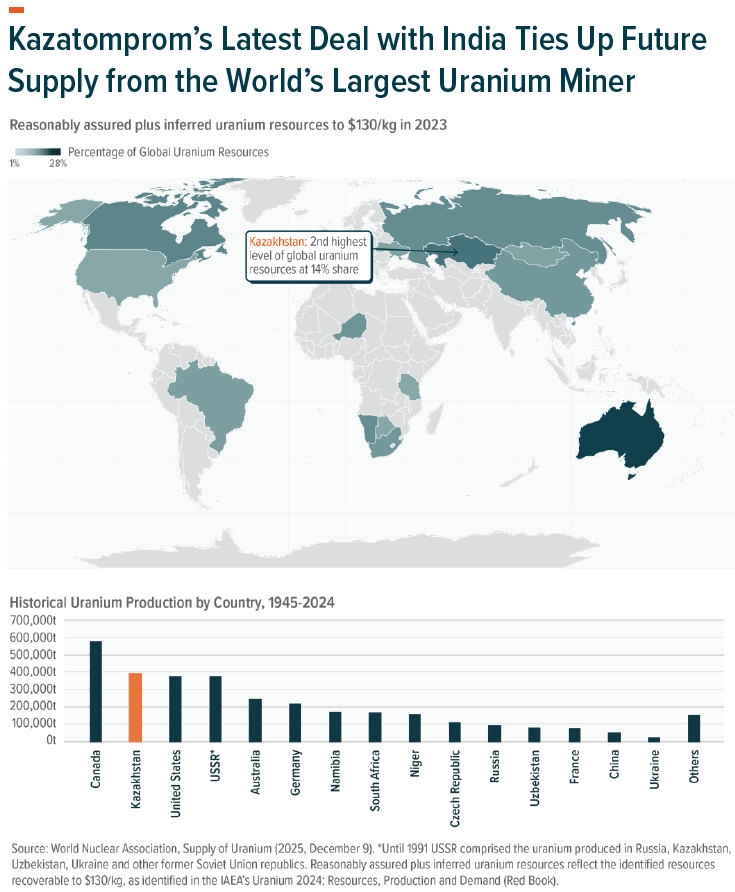
If approved, the supply deal between Kazatomprom (Kazakhstan’s National Uranium Company) and India amounts to nearly half of Kazatomprom’s booked asset value, effectively sequestering a large amount of future uranium output for government inventories.
Copper
Key Takeaway
Copper prices jumped following the U.S. Supreme Court decision invalidating select tariffs. Earnings season reflects margin improvements and strong revenue contributions from copper-related operations.
Copper prices rose following the February 22nd U.S. Supreme Court decision striking down emergency levies issued under the International Emergency Economic Powers Act (IEPPA).11 The decision effectively lowers tariffs on a relative basis for industrial consumers like China, Brazil, and India, with weighted average tariffs for Asian buyers falling to 17% from 20% under the U.S. administration’s new global rate, and China specifically seeing its weighted average levy decline to 24% from 32%.12
While the near-term relief to markets could be temporary, the resulting impact of the Supreme Court ruling was interpreted as largely beneficial to metals markets.13
Initial earnings reported by copper miners are at multi-year highs, thanks to elevated metals prices and record low treatment and refining charges (TC/RCs). Copper prices averaged $9,954/t in 2025, their highest recorded annualized price, and advanced to surpass $13,000/t in 2026.14 Mining of by-products from copper operations, like gold and silver which are also trading at or near historic highs, have generated ancillary revenues and enhanced margins for copper miners. Finally, record low TC/RC charges due to the proliferation of copper smelters have greatly reduced fees paid by miners to process their copper offtake, reducing a significant cost of doing business.15
Diversified global miners like BHP Group and Rio Tinto reported earnings that were heavily driven by copper operations, with nearly 51% and 30% of each company’s operating earnings attributable to copper. Copper even overtook iron ore in its contribution to overall revenues in BHP’s case.16 Noteworthy have been industry attempts to acquire new long-term copper deposits as miners seek to expand M&A activities. This was illustrated by breakdowns in negotiations between BHP and Anglo American and Rio Tinto and Glencore, both of which failed to proceed over disagreements in valuation. This reflects the rising difficulty of acquiring new mines, rising premiums for copper assets, and higher expected terminal values for assets.
PRICE ACTION
Copper prices broke all-time highs at the end of January, briefly hitting a record of $14,527, its largest move since 2008.17 While prices since pulled back to $13,000 in late February, they continue to trade at elevated levels as traders await news of Chinese industrial demand in the aftermath of the Lunar New Year.18
- Reported Chinese copper inventories are greater than usual, with stockpiles in privately held copper inventories jumping to their highest level since 2020, signaling a near-term pullback in physical demand.19
OUTLOOK
We believe the end of the Chinese New Year signals a return to form for copper markets, as industrial buyers return to market amidst a more favorable global trade regime. The U.S. Supreme Court decision reverting several tariffs set under IEPPA also begets a more favorable demand regime for emerging markets and copper producers. We highlight that copper-specific tariffs issued under Section 232 remain in effect and are unrelated to February’s supreme court ruling. Although the near-term outlook is uncertain, we remain optimistic on copper’s trajectory in late 2026 amidst the potential return of the dollar debasement trade.
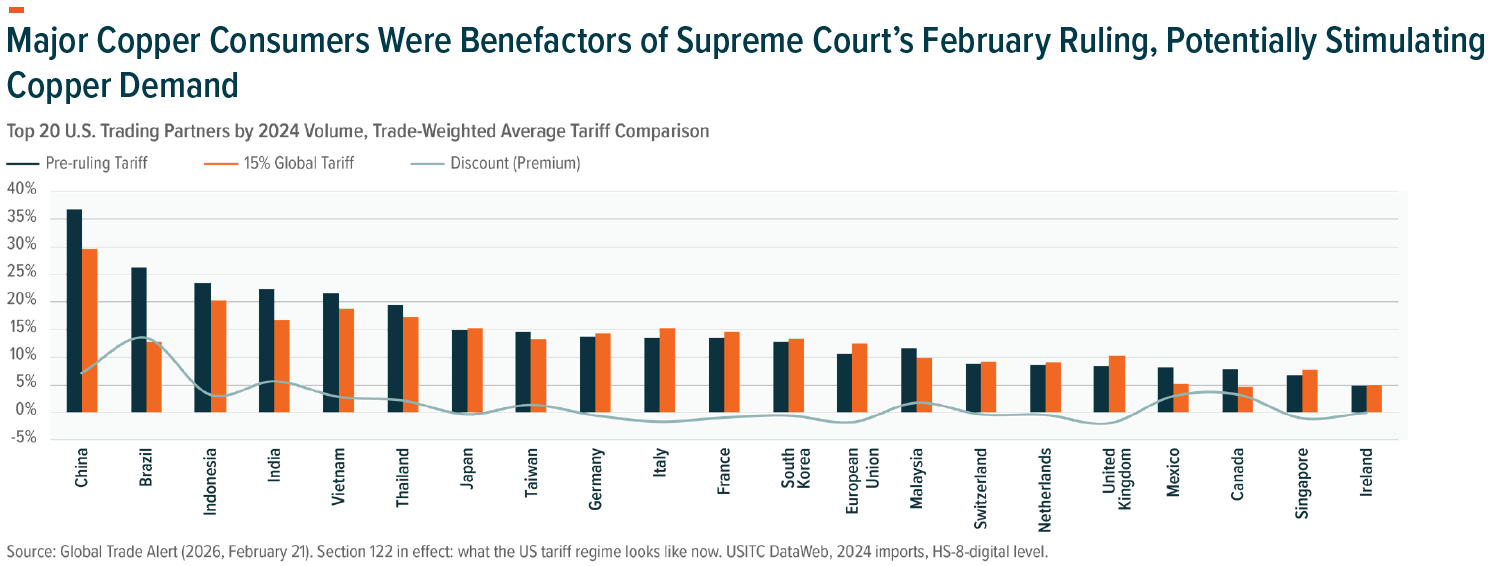
The U.S. Supreme Court’s February ruling could potentially stimulate industrial consumption as global exporters [MS1.1]realize lower-weighted average tariffs under the U.S. administration’s new 15% flat rate.
Precious Metals
Key Takeaway
Early February saw precious metals experience their highest volatility in nearly a decade, before retracing much of their losses by the end of the month. Despite choppy waters in commodity prices, Q4 gold miner earnings reflected record profit hikes and positive outlooks.
Gold miner earnings for Q4 2025 are rolling in with certain names potentially reporting their greatest quarterly performances ever.20 Barrick Mining saw its adjusted net profit after tax more than double year-over-year; Newmont Corp. posted its fifth straight earnings and revenue beat, growing gold sales 23% YoY;21 and Freeport McMoran topped earnings estimates, growing net income to $406 million from $274 million in the previous year, despite disruptions at its Grasberg copper mine.22
Following late-January volatility, the CME Group raised its margin requirements for gold and silver futures for the third time since January 13th. Margins are collateral deposits that traders must provide to cover potential losses and can be increased during periods of heightened volatility as a precaution. Initial and maintenance margins were raised to 9% from 8% for COMEX 100 gold futures and 18% from 15% for COMEX 5000 silver futures.23
PRICE ACTION
After an incredible run in 2025, gold prices experienced their biggest slump in nearly a decade in early February, with the entire metals complex seeing heavy price volatility, including silver, platinum, and base metals. The key trigger for the selloff was surprise dollar strength, initiated by the unexpected nomination of Kevin Warsh as the next U.S. Fed Chair.24 Despite early month volatility, precious metals prices largely retraced their losses in late February, with gold more recently retesting the $5,185/oz level as of February 26th.25
- Last year was a particularly active one for precious metals: silver ended 2025 in its 5th consecutive annual supply deficit, compounded by low supply elasticity and strong industrial demand.26 Consistent uptake in electrification and photovoltaics continue to draw down silver inventories and add to tightness in physical markets.
- Gold prices set 53 new all-time highs in 2025 while total gold supply only grew 1%.27 Total gold demand also exceeded 5,000 tonnes for the first time in 2025, accompanied by a nearly 45% YoY price advance. Gold ETFs and bar/coin purchases were the largest contributors to gold purchases, even as Central Bank purchases remained elevated.28
OUTLOOK
We think the early February correction allowed for healthy consolidation after the trade in precious metals grew overextended. We remain positive on the structural bull market in precious metals and highlight that all the fundamental drivers of this rally remain in play, including central bank reserve purchases, currency debasement, and recovering industrial demand. We believe late February’s Supreme Court ruling reintroduces trade-related volatility in the market while also reducing the relative burden from tariffs imposed on nations like China, factors that could act as individual catalysts for both gold and silver given their historic roles as risk hedges in volatile environments. We believe miners may continue to benefit from heightened commodity prices with an emphasis on increased operational efficiencies.
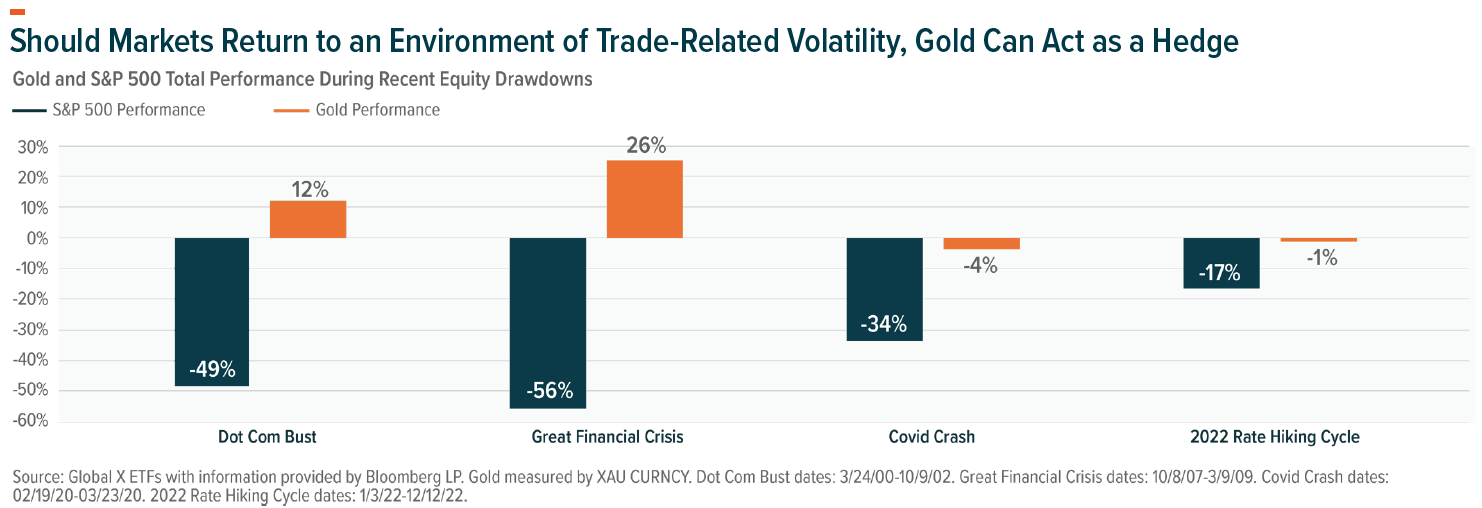
The February 22nd Supreme Court ruling led the Trump Administration to issue 15% global tariffs as a temporary measure for 150 days. This could return markets to an environment of tariff-related uncertainty, potentially resulting in further dollar debasement and heightened trade risks, an environment in which gold can thrive.
Critical Minerals, Battery Tech & Lithium
Key Takeaway
Supply-side fundamentals tightened for both lithium and rare earths. Africa’s largest lithium producing nation suspended exports of lithium concentrates, while rare earth supply chain constraints led two U.S. aerospace suppliers to pause production.
Zimbabwe, Africa’s largest lithium producer in 2025, suspended all exports of lithium concentrates on February 25th with no end date offered. In a letter to mining companies, the Zimbabwe government noted its intent to streamline export permitting and crack down on export malpractices. The country ranked fourth in lithium production in 2025 with 132 kt LCE, accounting for nearly 10% of the world’s mined lithium supply. As such, the latest suspension has the potential to further tighten global lithium supplies, pressuring prices upward in a market that already saw lithium prices double since December of 2025.29
Two U.S. aerospace suppliers temporarily paused production this month and were forced to turn away clients as U.S. firms face worsening shortages of yttrium and scandium, two members of the rare earths family. Prices for yttrium, which is used as a coating in turbines due to its high melting point, have jumped 60% since November and are 69 times higher year-over-year.30 Meanwhile supplies of scandium, a key input in advanced chip processing for 5G technology, are running low as U.S. chipmakers noted delays in receiving new export licenses from China.31
PRICE ACTION
Strong magnet demand and Chinese supply management continue to drive the surge in rare earth prices. Producer restocking that coincided with the Lunar New Year and limited quota hikes have further tightened spot liquidity and led statelinked producers to guide for higher prices.32 Meanwhile lithium prices advanced to ~$19,000/tonne following supply disruptions in Zimbabwe.33
- Prices of neodymium and praseodymium (NdPr) rallied to $123 by February 18th on firm demand and supply bottlenecks. The prices of these two rare earths have nearly doubled over the past seven months and are now past the $110/kg price floor negotiated between MP Materials and the U.S. government.34
- Despite a sustained advance in rare earth prices, rare earth companies experienced volatility in late January, as U.S. government officials signaled a pullback to the minimum price floor guarantees that markets had been anticipating. This signals a potential reversal in policy and a tacit acknowledgement of the complexities of obtaining congressional funding and market price setting mechanisms. We note that the shift may guide the structure of future critical mineral deals and does not affect previous price floor commitments already made to MP materials.35
OUTLOOK
Supply-side fundamentals continue to tighten across both lithium and rare-earths markets, with supply shortages and material rationing at U.S. aerospace and semiconductor firms underscoring the gravity of the matter. While President Trump is set to meet with Chinese President Xi Jinping at an upcoming summit on March 31st, February’s Supreme Court decision throws considerable uncertainty into the outcome of those trade negotiations and could add further volatility to the critical minerals trade.36
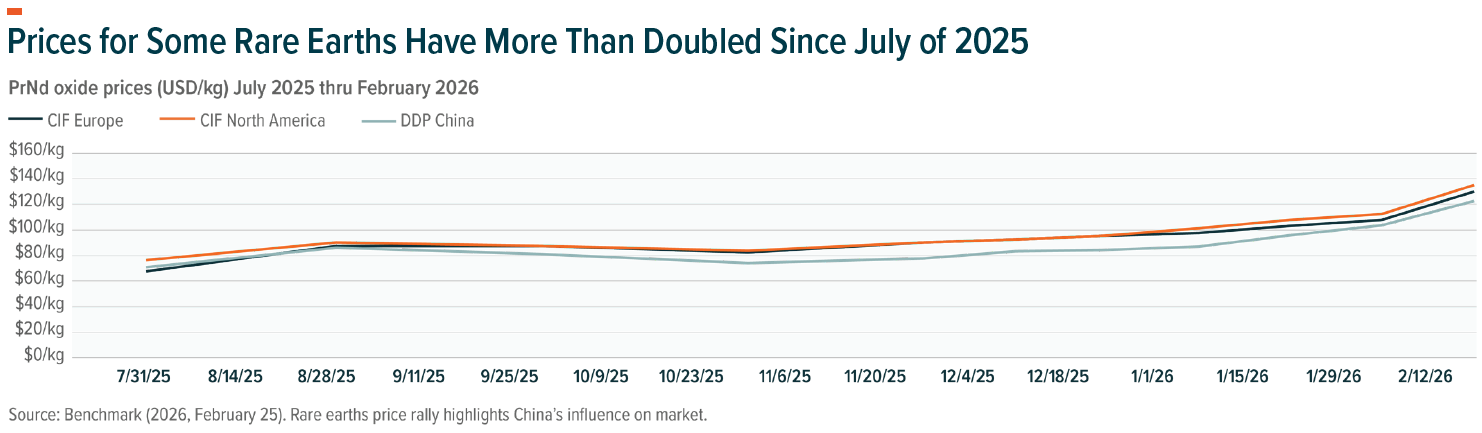
Following China’s implementation of rare earth export restrictions, prices for certain critical rare earth minerals like PrNd have more than doubled in recent months, leading to production pauses and material rationing at aerospace and semiconductor firms.
Related ETFs
COPX – Global X Copper Miners ETF
SIL – Global X Silver Miners ETF
EART – Global X Rare Earth & Critical Materials ETF
AUAU – Global X Gold Miners ETF
LIT – Global X Lithium & Battery Tech ETF
2646 – Global X Japan Metal Business ETF
424A – Global X Gold ETF (JPY Hedged)
578A – Global X Silver ETF (JPY Hedged)
579A – Global X Silver Miners ETF
580A – Global X Copper Miners ETF
609A – Global X Japan Wholesale Trade & Resource Business ETF
Click the fund name above to view current performance and holdings. Holdings are subject to change. Current and future holdings are subject to risk.
